
Machine manufacturers require complete visibility into the health and performance of machines installed at customer sites to enhance industrial data acquisition. Traditional service models often depend on reactive maintenance, leading to unexpected downtime, increased warranty costs, and customer dissatisfaction.
The Industrial Data Acquisition Platform (IDAP) empowers OEMs to securely collect operational data, facilitating remote asset monitoring, detecting anomalies, and implementing predictive maintenance. It integrates PLCs, CNCs, sensors, SCADA, and edge devices into a unified cloud-based Industrial IoT ecosystem.
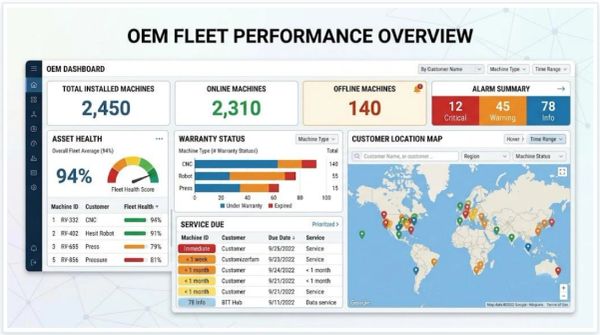
Machine manufacturers require complete visibility into the health and performance of machines installed at customer sites to enhance industrial data acquisition. Traditional service models often depend on reactive maintenance, leading to unexpected downtime, increased warranty costs, and customer dissatisfaction.
The Industrial Data Acquisition Platform (IDAP) empowers OEMs to securely collect operational data, facilitating remote asset monitoring, detecting anomalies, and implementing predictive maintenance. It integrates PLCs, CNCs, sensors, SCADA, and edge devices into a unified cloud-based Industrial IoT ecosystem.
There is no visibility into the industrial data acquisition from machines installed at customer sites. Maintenance strategies are reactive and primarily driven by breakdowns, resulting in high field service costs. Additionally, there is no capability for predictive maintenance, making root-cause analysis difficult. Remote asset monitoring could enhance visibility and enable proactive maintenance strategies.

Our fleet features multiple controller brands, leading to challenges in industrial data acquisition. The service reporting lacks consistency and is often manual, complicating our predictive maintenance efforts. Furthermore, spare parts planning is insufficient, and we have no analytics on machine utilization. This lack of data makes it difficult to detect warranty misuse and hampers our remote asset monitoring capabilities.
Machine manufacturers require complete visibility into the health and performance of machines installed at customer sites to enhance industrial data acquisition. Traditional service models often depend on reactive maintenance, leading to unexpected downtime, increased warranty costs, and customer dissatisfaction.
The Industrial Data Acquisition Platform (IDAP) empowers OEMs to securely collect operational data, facilitating remote asset monitoring, detecting anomalies, and implementing predictive maintenance. It integrates PLCs, CNCs, sensors, SCADA, and edge devices into a unified cloud-based Industrial IoT ecosystem.

There is no visibility into the industrial data acquisition from machines installed at customer sites. Maintenance strategies are reactive and primarily driven by breakdowns, resulting in high field service costs. Additionally, there is no capability for predictive maintenance, making root-cause analysis difficult. Remote asset monitoring could enhance visibility and enable proactive maintenance strategies.

Our fleet features multiple controller brands, leading to challenges in industrial data acquisition. The service reporting lacks consistency and is often manual, complicating our predictive maintenance efforts. Furthermore, spare parts planning is insufficient, and we have no analytics on machine utilization. This lack of data makes it difficult to detect warranty misuse and hampers our remote asset monitoring capabilities.

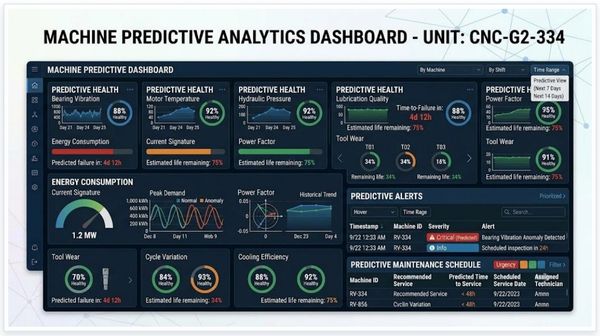
Monitoring bearing vibration, motor temperature, hydraulic pressure, lubrication quality, and energy consumption is crucial for effective industrial data acquisition. These metrics, along with current signature and power factor analysis, play a vital role in predictive maintenance and enhance our understanding of tool wear, cycle variation, and cooling efficiency. Furthermore, implementing remote asset monitoring ensures that these parameters are continuously tracked for optimal performance.
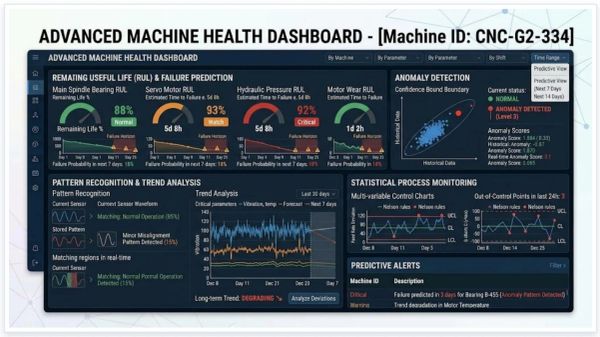
Failure prediction and anomaly detection are crucial components of industrial data acquisition, enabling effective trend analysis and pattern recognition. These processes play a vital role in predictive maintenance and remote asset monitoring through statistical process monitoring.

The parameters monitored in industrial data acquisition for predictive maintenance include temperature, vibration, current, and runtime. Additionally, insights on production rate and production trend can be tracked, alongside alarm frequency and lubrication status. Historical failures are also recorded to enhance remote asset monitoring and improve overall reliability.
There is no visibility into the industrial data acquisition from machines installed at customer sites. Maintenance strategies are reactive and primarily driven by breakdowns, resulting in high field service costs. Additionally, there is no capability for predictive maintenance, making root-cause analysis difficult. Remote asset monitoring could enhance visibility and enable proactive maintenance strategies.
Our fleet features multiple controller brands, leading to challenges in industrial data acquisition. The service reporting lacks consistency and is often manual, complicating our predictive maintenance efforts. Furthermore, spare parts planning is insufficient, and we have no analytics on machine utilization. This lack of data makes it difficult to detect warranty misuse and hampers our remote asset monitoring capabilities.
Machine manufacturers require complete visibility into the health and performance of machines installed at customer sites to enhance industrial data acquisition. Traditional service models often depend on reactive maintenance, leading to unexpected downtime, increased warranty costs, and customer dissatisfaction.
The Industrial Data Acquisition Platform (IDAP) empowers OEMs to securely collect operational data, facilitating remote asset monitoring, detecting anomalies, and implementing predictive maintenance. It integrates PLCs, CNCs, sensors, SCADA, and edge devices into a unified cloud-based Industrial IoT ecosystem.
There is no visibility into the industrial data acquisition from machines installed at customer sites. Maintenance strategies are reactive and primarily driven by breakdowns, resulting in high field service costs. Additionally, there is no capability for predictive maintenance, making root-cause analysis difficult. Remote asset monitoring could enhance visibility and enable proactive maintenance strategies.
Our fleet features multiple controller brands, leading to challenges in industrial data acquisition. The service reporting lacks consistency and is often manual, complicating our predictive maintenance efforts. Furthermore, spare parts planning is insufficient, and we have no analytics on machine utilization. This lack of data makes it difficult to detect warranty misuse and hampers our remote asset monitoring capabilities.
Monitoring bearing vibration, motor temperature, hydraulic pressure, lubrication quality, and energy consumption is crucial for effective industrial data acquisition. These metrics, along with current signature and power factor analysis, play a vital role in predictive maintenance and enhance our understanding of tool wear, cycle variation, and cooling efficiency. Furthermore, implementing remote asset monitoring ensures that these parameters are continuously tracked for optimal performance.
Failure prediction and anomaly detection are crucial components of industrial data acquisition, enabling effective trend analysis and pattern recognition. These processes play a vital role in predictive maintenance and remote asset monitoring through statistical process monitoring.
The parameters monitored in industrial data acquisition for predictive maintenance include temperature, vibration, current, and runtime. Additionally, insights on production rate and production trend can be tracked, alongside alarm frequency and lubrication status. Historical failures are also recorded to enhance remote asset monitoring and improve overall reliability.
Machine manufacturers require complete visibility into the health and performance of machines installed at customer sites to enhance industrial data acquisition. Traditional service models often depend on reactive maintenance, leading to unexpected downtime, increased warranty costs, and customer dissatisfaction.
The Industrial Data Acquisition Platform (IDAP) empowers OEMs to securely collect operational data, facilitating remote asset monitoring, detecting anomalies, and implementing predictive maintenance. It integrates PLCs, CNCs, sensors, SCADA, and edge devices into a unified cloud-based Industrial IoT ecosystem.

Our fleet features multiple controller brands, leading to challenges in industrial data acquisition. The service reporting lacks consistency and is often manual, complicating our predictive maintenance efforts. Furthermore, spare parts planning is insufficient, and we have no analytics on machine utilization. This lack of data makes it difficult to detect warranty misuse and hampers our remote asset monitoring capabilities.